A white wine nobody drinks
The appellation covers more than 87,648 hectares and supports 4,251 growers and distilling growers, at an average of twenty hectares per estate. Over 98 % of that surface is planted with Ugni Blanc.
The variety ripens late and yields an acidic wine of low strength, around 9 % ABV. As a table wine it would be unbearable. For distillation it is exactly right. The acidity preserves the wine without any need for sulphiting, and a low strength forces you to distil large volumes, which concentrates the aromatics.
Picking starts around mid-September and ends in mid-October, almost always by machine. Pressing follows immediately, in batch pneumatic presses at low pressure. No added sugar, no sulphites during fermentation. Three weeks later the wine goes to the still.
During the distilling season I sometimes pour visitors a glass of that wine. The reaction never varies: a grimace. Which is the point.
Two heats, and one cut
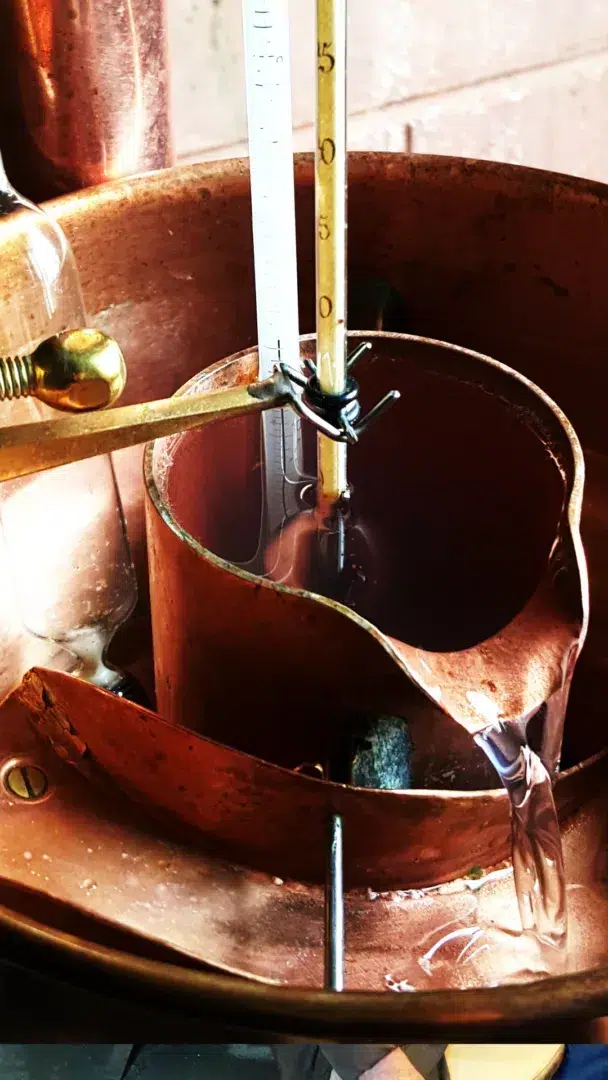
The Charentais still has not changed in principle since the seventeenth century. A copper boiler over a naked flame, a head shaped like a Moor’s head, an olive or an onion, a swan neck running into a coil through a basin of cold water. Many stills carry a wine heater, which uses the heat of the vapours to pre-warm the next charge. Close to 3,000 stills are in operation across the appellation today.
First heat. The wine, often kept on its fine lees, is brought to the boil. What comes off is a cloudy liquid at 28 to 32 % ABV, known as the brouillis.
Second heat, the bonne chauffe. The brouillis goes back into a boiler whose capacity the production rules cap at 30 hectolitres, with a charge limited to 25. This is where the cut happens. The first fractions, the heads, are set aside. Then comes the heart, clear and bright, which will become cognac. Then the seconds, once the alcoholmeter drops below 60 % ABV, and finally the tails. Heads and seconds go back into a later cycle.
One cycle runs about twenty-four hours. Distilleries work day and night from November to March, and distillation must be finished by 31 March following the harvest.
If you only remember one stage, make it this one. Two distillers given the same wine will not hand back the same spirit. The proportion of lees, the exact moment of the cut, the heating curve: those calls are made by hand, often at three in the morning. It is also why I steer visitors travelling in winter towards a night distillation rather than a late-afternoon tasting room. Those night visits run by appointment only and need to be booked several days ahead: one of the few things around here that cannot be improvised.
The cask is not a container
Stave wood is split, never sawn, so that the grain stays intact. It then seasons outdoors for two to three years, long enough for rain to leach out the harshest tannins. The cooper bends the staves over a fire of oak chips, tightens the hoops by degrees, then toasts the inside of the cask. That toasting, light or heavy, already shapes the aromatic profile of a spirit that has not yet gone in. No glue, no nails at any point.
Two oaks dominate. Limousin (Quercus robur), wide-grained, gives up its tannin quickly and generously. Tronçais, in the Allier (Quercus petraea), fine-grained, gives less tannin and more vanilla. The Charentais reference size is 350 litres.
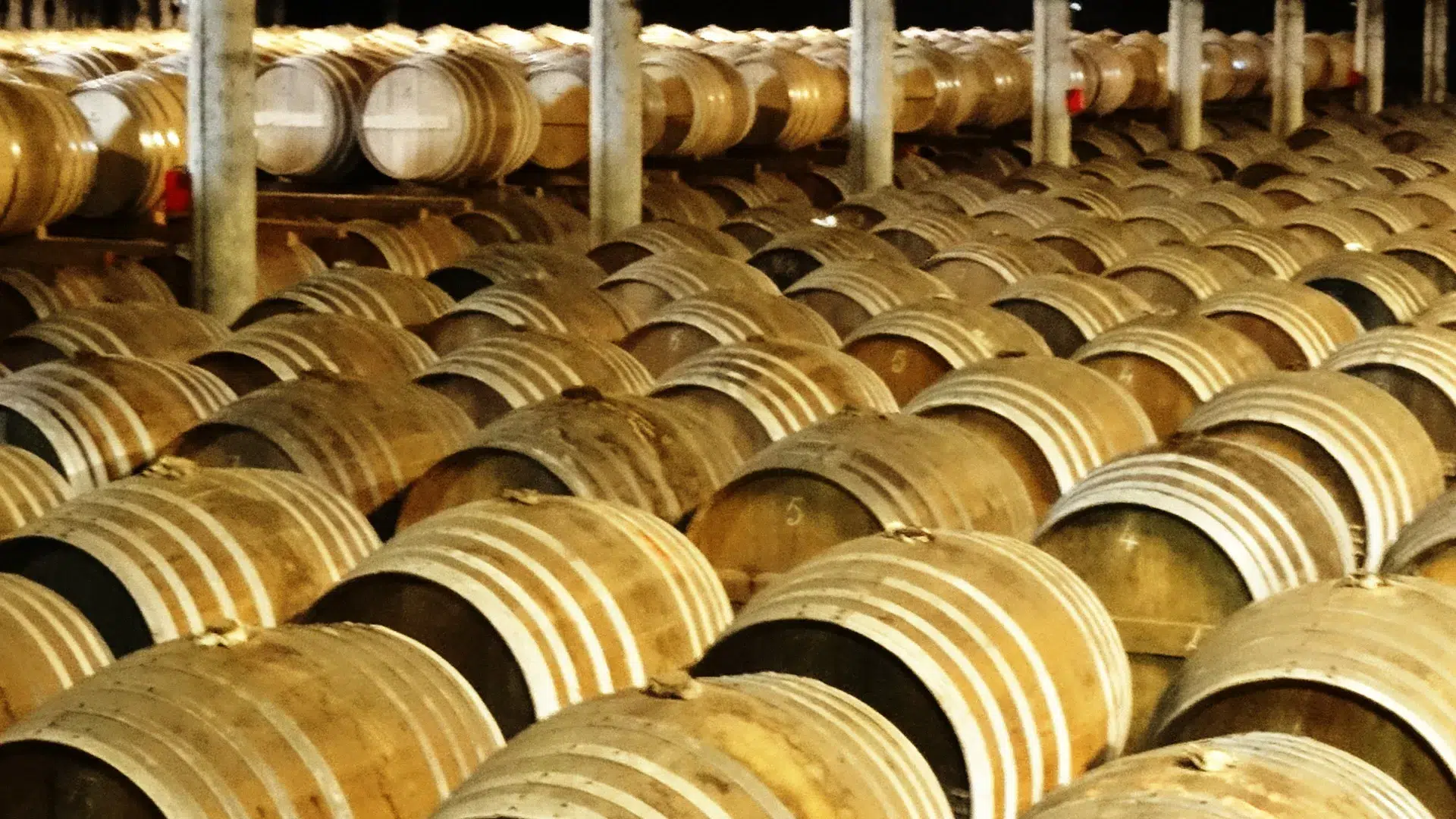
The choice that matters most, though, is not the species but the age of the cask. New spirit usually spends only a few months in new oak; beyond that the wood covers everything. It ends its life in exhausted casks that give almost nothing and serve mainly to let it breathe.
Time, and what it costs
Ageing works in three movements. The spirit first dissolves what the wood has to give: colour, tannin, early vanilla notes. Those compounds then transform slowly in contact with alcohol and water. Finally oxidation, very slow, rounds the whole thing off and brings out rancio, the notes of undergrowth, mushroom and walnut oil that mark old spirits.
Cellar humidity decides the direction. A damp cellar: alcohol evaporates faster than water, the cognac softens and loses strength. A dry cellar: the reverse, it concentrates and hardens. Houses use both, and move casks between them.
The angels’ share is that evaporation, roughly 2 % of stock a year, equivalent to 41 million bottles in 2025 alone. Those vapours feed a microscopic fungus that blackens the walls and roofs around the cellars. Described in 1881 as Torula compniacensis, it was reclassified by mycologists in 2007 as Baudoinia compniacensis. The name changed; the facades did not. It is the first thing I point out on arriving in Cognac, before any distillery: those black streaks tell you where the cellars are.
Once a spirit has stopped evolving, it leaves the wood for glass demijohns, the dames-jeannes, where it keeps for decades without further change. The dark cellar that holds them is called the paradis. It genuinely exists, and it is almost never open to visitors.
Blending, the part you do not see
Nothing in the production rules obliges a producer to blend. Almost everyone does. The cellar master marries spirits of different ages and different crus to deliver, year after year, a house style you can recognise blind. He also adjusts the strength, adding distilled or demineralised water in very small increments down to the regulatory minimum of 40 % ABV. That operation is called reduction, or dilution in the BNIC’s own English, and it takes months.
It is the least photogenic stage to show a group, and the most decisive. A grower can hold beautiful spirits and still release an unremarkable cognac. The reverse does not happen.
What it changes once you are here
Knowing the sequence does not make you a better taster. It makes the visit start faster. You no longer need twenty minutes of explanation about what brouillis is; you can ask the distiller why he cuts his seconds at that point rather than another. The conversation shifts register, and the producer notices at once.
That is what we look for in our cognac workshops and distillery visits, our private guided excursions through the vineyard and our stays in the Charentes: appointments with producers willing to go past the welcome speech.
At several estates whose owners I know well, I lead the whole visit myself and the owner joins us for the tasting. The difference shows at once. Visitors have already walked the cellars and followed the reasoning; they arrive with real questions, and the exchange stops sounding like a presentation.
Sources
- BNIC, Cognac in figures (in French), data to end December 2025.
- BNIC, Origin and production process.
- INAO, specification for the Cognac controlled designation of origin, approved by the order of 20 February 2025.
- Scott, Untereiner, Ewaze, Wong & Doyle, Baudoinia, a new genus to accommodate Torula compniacensis, Mycologia, 2007.